
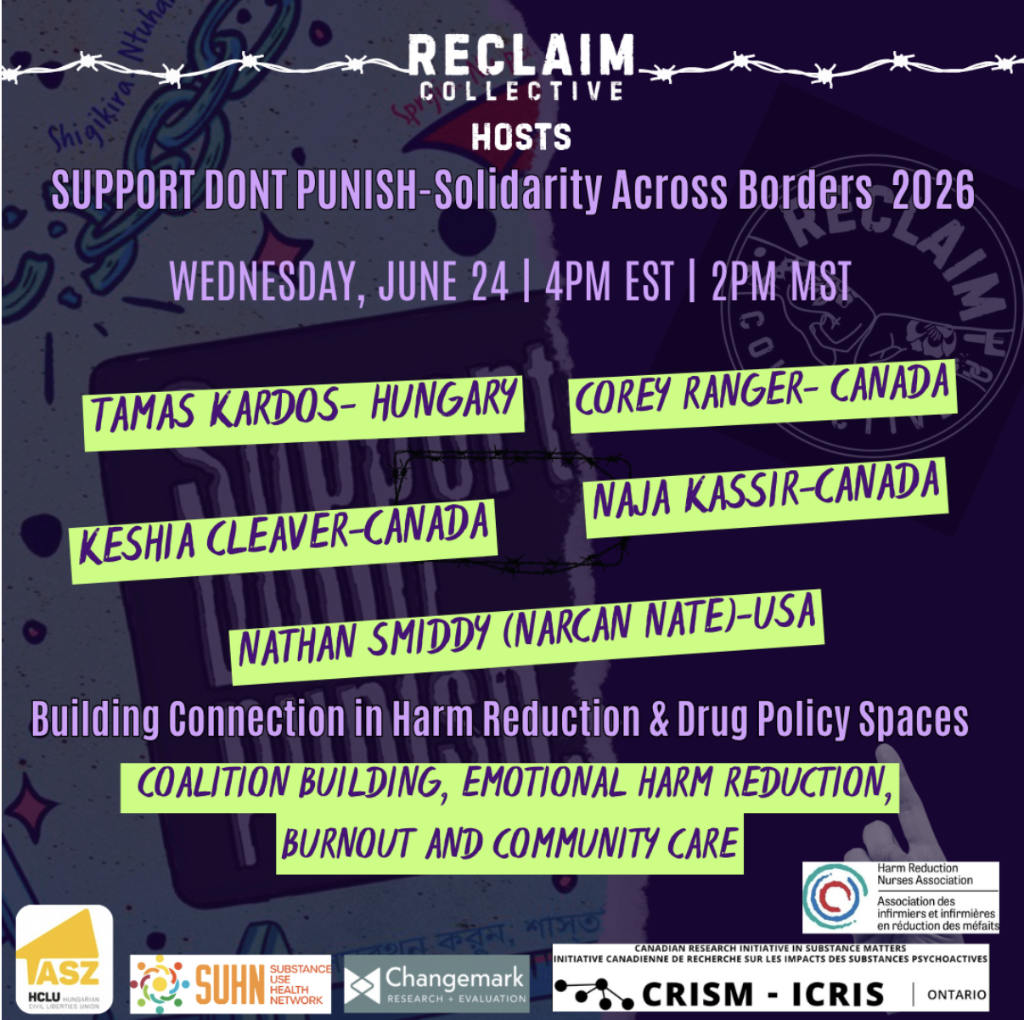
RECLAIM Collective is excited to announce our upcoming Support. Don’t Punish 2026 webinar, the first event in a three-part webinar series. Building on the success of RECLAIM’s Solidarity Across Borders webinar for Support. Don’t Punish Day last year, this year’s series begins with a focus on strengthening connection across our communities and movements.
This panel will feature leading drug policy and harm reduction advocates from Europe, the United States, and Canada. Drawing on expertise in street outreach, healthcare, drug policy, Indigenous wellness, mutual aid, and human rights advocacy, panelists will share insights on building and sustaining connection in the face of growing challenges.
This webinar is about coming together strategically as harm reductionists, caring for each other, building strong coalitions, engaging in good faith, and ensuring that we do not cause harm within our own movements. As we navigate challenging political and social environments, we believe it is important to strengthen relationships, foster solidarity, and create space for honest dialogue while working toward shared goals.
Our first webinar, Building Connection in Harm Reduction & Drug Policy Spaces, will explore emotional harm reduction, burnout, grief, accountability, coalition building, and navigating differences within harm reduction spaces during a time of growing stigma, service closures, political attacks, and funding cuts across Canada and beyond.
Speaker bios and registration details are included below. This webinar will have lots of time for Q&A and discussion. We hope you’ll join us for this important global, action-based conversation.
Click Here to Register for the Webinar
Nathan Smiddy – Nathan became involved in this work after realizing that policy failures and a lack of resources were contributing to the deaths of people in his community, including after finding someone who had overdosed in a halfway house. He has been providing naloxone training for almost eight years and currently runs an underground SSP in the southern United States. He also manages a small mutual aid program in California that conducts outreach with people who are unhoused and may be using substances. His work has included everything from setting up shower trailers for refugees to engaging with stakeholders connected to the U.S./Mexico border. Nathan’s work is grounded in a deep commitment to people and a belief that existing systems have too often failed those most affected by poverty, substance use, and criminalization.
Corey Ranger – Based in unceded Quw’utsun Territory, Corey (he/him) is an uninvited settler on these lands. Corey is a Registered Nurse with extensive experience in street outreach, community, and public health nursing, with additional training in project management and quality improvement. Corey has focused primarily on harm reduction since 2013, beginning in Alberta and now in British Columbia. At present, Corey is the Clinical Director at AVI Health & Community Services, President of the Harm Reduction Nurses Association, a Board Director at the Canadian Drug Policy Coalition (CDPC), and the North American Representative for the Members’ Advisory Council with the International Drug Policy Consortium (IDPC).
Keshia Cleaver – Keshia Cleaver is a Tla’amin Nation woman with over 15 years of experience working in harm reduction, substance use, and mental health in and for Indigenous communities. She has spent her career developing and delivering culturally safe, community-driven programs and has facilitated hundreds of workshops and trainings across British Columbia. She holds a Master of Arts from the University of Victoria and is beginning her PhD in the Social Dimensions of Health in Fall 2026, with research focused on food sovereignty and Indigenous wellness in Vancouver’s Downtown Eastside. Keshia brings both professional expertise and lived experience of substance use, mental health challenges, and houselessness to her work, and is deeply committed to harm reduction approaches that are community-led, relational, and rooted in Indigenous ways of knowing.
Naja Kassir – Naja Kassir is a Lebanese writer, educator, and harm reduction advocate based in Montreal/Tiohtià:ke. Over the past several years, she has worked on knowledge translation and educational initiatives that promote cross-sector collaboration around harm reduction and evidence-based drug policy. She has been involved in developing webinar series, speaking at conferences, coordinating regional meetings, and fostering partnerships ranging from grassroots organizing efforts to human rights advocacy organizations.
Naja’s work is grounded in a commitment to building broader solidarity across movements to challenge policies that impoverish and disempower people while exploiting resources in service of capitalism and colonialism. She was most recently published in the anthology El-Ghourabaa in 2024. Outside of her advocacy work, she can often be found reading her writing at community events, fundraising for important causes, and helping organize local community initiatives.
Tamás Kardos – Tamás is a drug policy expert at the Hungarian Civil Liberties Union (HCLU/TASZ). He was previously the lead author and editor of Medijuana Magazine, and his work has been featured in Revista Cáñamo España, TalkingDrugs, the Paradise Seeds blog, and Drugreporter.
Tamás consistently advocates for the decriminalization of drug use, highlighting the drawbacks of the existing criminal law approach. He emphasizes the importance of evidence-based strategies and the need for harm reduction.
He was actively involved in developing Budapest’s first Drug Strategy for harm reduction and supply reduction, which the Municipality of Budapest adopted in 2023. As a committed advocate for patients’ rights, he organized Hungary’s first Medical Cannabis Conference. His areas of focus include medical cannabis, harm reduction, human rights, and the intersection of drug policy and law enforcement